
Pregnancy Aches: What’s Normal, What Isn’t, and What Actually Helps
Some pregnancy aches are normal. Being in pain that stops you sleeping, walking or working is not something you simply have to put up with.
1Why Pregnancy Changes How Your Body Loads
Three things happen at once, and together they explain most pregnancy aches.
- Relaxin increases ligament laxity throughout the body, not just the pelvis. Joints that were previously stable become less so.
- Your centre of gravity shifts forward, increasing the curve in the lower back and changing how the pelvis and hips are loaded.
- The abdominal wall lengthens, reducing the support it normally provides to the trunk.
None of that is pathological. It is a body doing exactly what it should. But it does mean tissues get loaded in unfamiliar ways, and some of them object.
2Pelvic Girdle Pain and SPD
Pain at the front of the pubic bone, across the back of the pelvis, or both. Classically worse when the legs move apart or independently — rolling over in bed, getting out of the car, climbing stairs, putting on trousers standing up.
Around one in five pregnancies involves meaningful pelvic girdle pain. It is common, it is treatable, and it is not something you simply endure until delivery.
Things that genuinely help:
- Keeping the knees together when rolling over or getting in and out of a car
- Sitting down to dress rather than balancing on one leg
- A pillow between the knees at night
- A pelvic support belt for some women — helpful for many, not all
- Hands-on treatment to settle the joints and surrounding muscles
3Back Pain, Rib Pain and Sciatica
Lower back pain is the most common complaint, driven by the shift in load and the reduced abdominal support. It usually responds well to hands-on treatment and some straightforward positional changes.
Rib and upper back pain tends to arrive later, as the growing uterus pushes upward and restricts the lower ribs. Gentle thoracic mobilisation often provides quick relief.
Sciatic-type pain in pregnancy is frequently not true sciatica but referred pain from the sacroiliac joint or from a tight piriformis. That is good news — it usually settles faster than genuine nerve compression.
4Is Treatment Safe in Pregnancy?
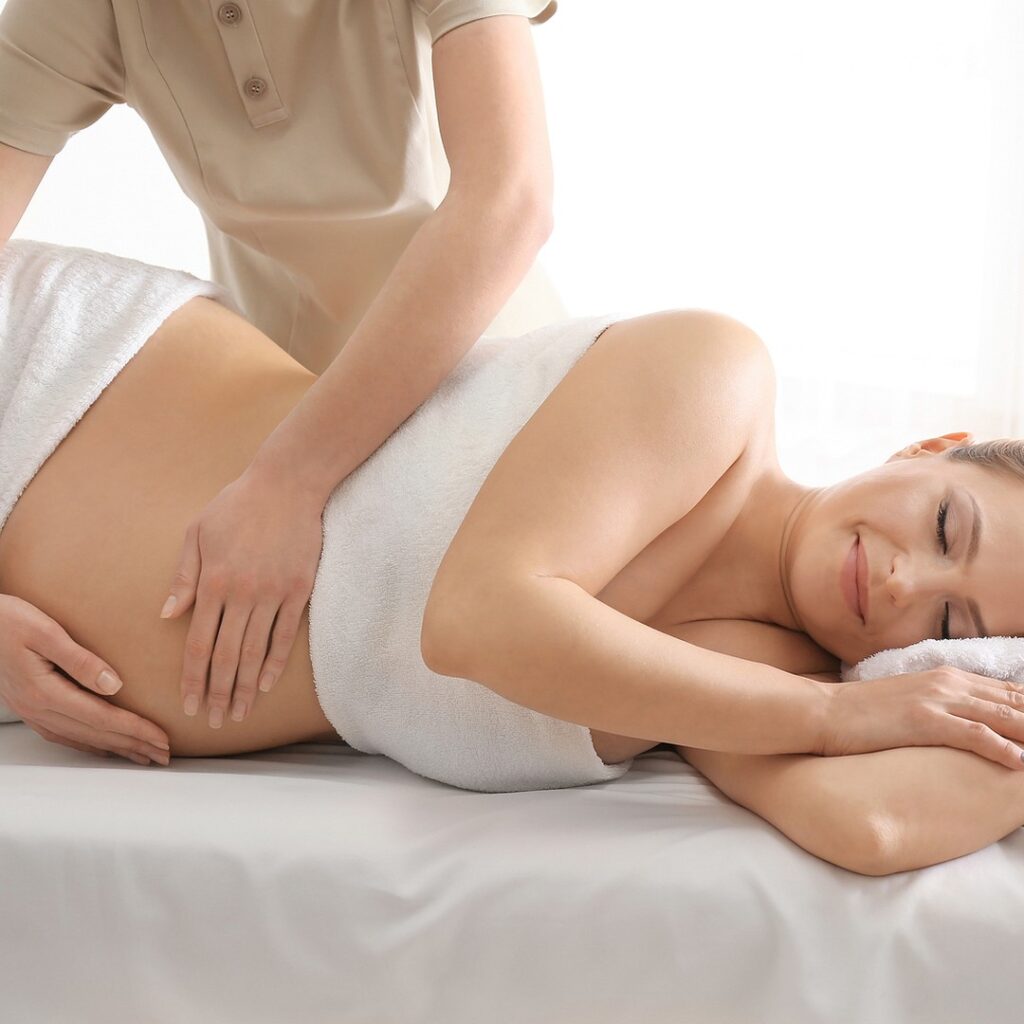
Yes, with practitioners experienced in treating during pregnancy.
Techniques are adapted throughout. After the first trimester you will be positioned side-lying or semi-reclined rather than flat on your front, using pillows and bolsters for support. Treatment is gentle — no forceful manipulation of the pelvis or lower back.
We treat throughout all three trimesters, and many women continue right up until delivery. Pregnancy massage and osteopathy during pregnancy are both available at Glenfield and Orewa.
If you have any pregnancy complications, we will ask you to check with your midwife or obstetrician first. That is routine caution rather than a red flag.
5Staying Comfortable Day to Day
Small changes compound:
- Sleep on your side with a pillow between the knees and one supporting the bump — left side is often recommended in later pregnancy for circulation
- Avoid standing on one leg to dress, and avoid sitting cross-legged for long stretches
- Keep moving, gently — walking and swimming are both excellent, and swimming unloads the pelvis beautifully
- Break up sitting every 30 minutes if you work at a desk
- Do not carry a toddler on one hip if you can avoid it — it is a significant asymmetric load
Pregnancy Aches and Pain — Common Questions
Is osteopathy safe during pregnancy?
Yes, when performed by a practitioner experienced in pregnancy care. Techniques are gentle and adapted for positioning and comfort. We treat across all three trimesters.
When should I start treatment?
Whenever the discomfort starts affecting sleep, walking or daily activities. There is no benefit to waiting, and pelvic girdle pain generally responds better the earlier it is addressed.
Will it help my labour?
We would not promise that. What treatment reliably does is reduce pain and improve pelvic and spinal mobility, which makes late pregnancy considerably more comfortable. Claims about shortening labour are not well supported by evidence.
Can I have a massage in the first trimester?
Many clinics prefer to wait until after 12 weeks as a precaution, and we follow that convention. It is caution rather than evidence of harm. Osteopathy can generally be provided earlier if needed.
Does ACC cover pregnancy pain?
Generally no, because it is not an accidental injury. It is treated privately. If you have Southern Cross cover, Easy-Claim may apply for eligible services.
Get comfortable again
Pregnancy osteopathy and massage at Glenfield and Orewa, all three trimesters.